In this comprehensive guide, you’ll learn everything you need to know about the Best Education Loan in India, including eligibility, interest rates, government schemes, repayment options, tax benefits, collateral requirements, and expert tips to help you make an informed decision before applying.
Higher education has become increasingly expensive in India. Whether you are planning to pursue engineering, medicine, management, law, or study abroad, tuition fees, hostel charges, books, laptops, travel expenses, and other educational costs can easily add up to several lakhs of rupees.
Many talented students postpone or even abandon their dreams because they cannot arrange the required funds on time.
Fortunately, education loans make quality education accessible by providing financial support with flexible repayment options. Banks, NBFCs, and government-backed schemes now offer student-friendly loans with competitive interest rates, long repayment tenures, and moratorium periods that allow students to repay only after completing their education.
What is the Best Education Loan in India?
The best education loan in India depends on several factors, including your course, college, loan amount, repayment capacity, and whether you are studying in India or abroad.
Generally, the best education loans offer:
- Competitive interest rates
- Flexible repayment tenure
- Moratorium period
- Minimal processing charges
- Higher loan limits
- Tax benefits under Section 80E
- Quick loan approval
- Easy online application
Students should always compare multiple lenders before applying.
Why Education Loans Are Becoming More Important in India
India has one of the world’s largest student populations. Every year, millions of students seek admission to universities, engineering colleges, medical colleges, management institutes, and foreign universities.
However, education costs continue to rise due to:
- Higher tuition fees
- Hostel expenses
- Technology requirements
- International education costs
- Living expenses
- Inflation
As a result, education financing has become an essential financial product for students and parents.
Education Loan Market in India (2026)
| Factor | Trend |
| Demand | Increasing rapidly |
| Study Abroad Loans | High growth |
| Online Loan Applications | Growing |
| Government Support | Expanding |
| Digital Verification | Faster approvals |
| NBFC Competition | Increasing |
| Flexible EMI Options | More common |
What is an Education Loan?
An education loan is financial assistance provided by a bank or financial institution to help students pay for eligible higher education expenses such as tuition, hostel fees, books, equipment, and related costs.
The loan usually covers:
- Tuition fees
- Hostel fees
- Examination fees
- Books
- Laptop
- Equipment
- Library charges
- Travel expenses
- Living expenses (selected cases)
- Overseas education costs
Repayment generally begins after completing the course and a predefined moratorium period.
Key Features of Education Loans
✔ Loan amount up to ₹3 Crore (selected lenders)
✔ Study in India and Abroad
✔ Moratorium available
✔ Flexible repayment
✔ Tax benefits
✔ Online application
✔ Competitive interest rates
✔ Women borrower concessions
✔ No prepayment penalty (many lenders)
Who Can Apply?
Education loans are available for students pursuing:
- Undergraduate courses
- Postgraduate courses
- Diploma courses
- Professional courses
- Technical education
- Medical education
- Engineering
- MBA
- Law
- Chartered Accountancy
- Aviation
- Skill Development Programs
- International Degree Programs
Parents, guardians, or co-applicants generally participate in the loan agreement.
Eligibility Criteria
Although eligibility varies among lenders, common requirements include:
Student Eligibility
- Indian citizen
- Confirmed admission
- Recognized institution
- Good academic record
- Eligible course
Co-Applicant Eligibility
- Parent
- Legal guardian
- Spouse (selected cases)
Must have:
- Stable income
- Good repayment history
- Acceptable credit score
Eligibility Table
| Criteria | Requirement |
| Nationality | Indian Citizen |
| Admission | Confirmed |
| Institution | Recognized |
| Academic Record | Satisfactory |
| Age | As per lender |
| Co-applicant | Usually Mandatory |
| Credit Score | Important for Co-applicant |
Types of Education Loans
Education loans are available in multiple categories.
1. Domestic Education Loan
Designed for students studying within India.
Suitable for:
- IITs
- NITs
- AIIMS
- Central Universities
- Private Universities
- Government Colleges
2. Study Abroad Loan
Covers international education expenses including:
- Tuition
- Visa
- Airfare
- Insurance
- Accommodation
- Living expenses
Popular destinations include:
- USA
- Canada
- UK
- Australia
- Germany
- Ireland
- Singapore
3. Professional Course Loan
Available for:
- MBA
- MBBS
- BDS
- Engineering
- Pharmacy
- Law
- Design
- Hotel Management
4. Skill Development Loan
Supports vocational education, certification programs, and industry-oriented skill development courses.
5. Government Sponsored Education Loans
Several government initiatives promote affordable education financing for eligible students through interest subsidies and special loan schemes.
Education Loan Interest Rates (Indicative 2026)
Interest rates differ across lenders and depend on factors such as loan amount, course, institution, credit profile, and collateral.
| Lender Type | Typical Interest Rate (Approx.) |
| Public Sector Banks | 8.00% – 11.00% |
| Private Banks | 8.50% – 13.50% |
| NBFCs | 9.50% – 15.50% |
| International Education Loans | Varies |
Note: Actual rates are determined by the lender and may change periodically. Always verify the latest rate on the official lender’s website before applying.
Factors Affecting Your Interest Rate
Banks evaluate several parameters before deciding the final rate.
These include:
- Credit score
- Co-applicant income
- University ranking
- Course
- Future earning potential
- Loan amount
- Loan tenure
- Collateral availability
A better financial profile often results in lower borrowing costs.
Government Education Loan Schemes
The Government of India supports higher education through several initiatives aimed at improving access to affordable financing.
Some of the well-known schemes include:
- Central Sector Interest Subsidy Scheme (CSIS)
- Credit Guarantee Fund Scheme for Education Loans (CGFSEL)
- Dr. Ambedkar Central Sector Scheme of Interest Subsidy
- Padho Pardesh (subject to current government policy)
- State Government Education Loan Subsidy Schemes
Students should check the latest eligibility and availability of these schemes, as policies may change over time.
Comparison of Government vs Private Education Loans
| Feature | Government-Linked Loans | Private Bank Loans |
| Interest Subsidy | Available for eligible students | Usually not available |
| Processing Speed | Moderate | Faster in many cases |
| Documentation | Extensive | Moderate |
| Loan Amount | Varies | Higher limits available |
| Flexibility | Standard | More customized options |
| Processing Fee | Often lower | Depends on lender |
Top Features to Compare Before Choosing an Education Loan
Never select a lender based only on the advertised interest rate. Compare these important factors:
- Interest rate
- Processing fee
- Loan amount
- Moratorium period
- Repayment tenure
- Prepayment charges
- Margin money
- Collateral requirements
- Insurance requirements
- Customer service
- Digital application process
- Approval timeline
Did You Know?
Many lenders finance not only tuition fees but also laptops, hostel charges, books, examination fees, travel expenses, and study materials—subject to the loan policy.
Pro Tip
Students admitted to premier institutions such as IITs, IIMs, NITs, AIIMS, IISc, and other reputed universities may receive more favorable loan terms, including lower interest rates or reduced collateral requirements.
Expert Insight
Choosing an education loan is a long-term financial decision. Compare the effective borrowing cost, repayment flexibility, moratorium period, customer support, and eligibility—not just the headline interest rate. A slightly higher interest rate with better repayment flexibility may prove more affordable over time.
Best Education Loan in India (2026): Top Banks, NBFCs, Documents, EMI & Repayment Guide
Disclaimer: Interest rates, loan limits, processing fees, and eligibility criteria vary by lender and may change over time. Always verify the latest information on the official website of the bank or financial institution before applying.
Best Public Sector Bank Education Loans
Public sector banks remain one of the most preferred choices for education loans due to competitive interest rates, transparent policies, and government-backed schemes.
1. State Bank of India (SBI)
SBI offers one of the most popular education loan products for students pursuing higher education in India and abroad.
Key Features
- Competitive interest rates
- Loan for domestic and overseas studies
- Long repayment tenure
- Moratorium period available
- Online application facility
- No hidden charges (subject to policy)
Best For
- Engineering students
- Medical students
- MBA aspirants
- Overseas education
2. Bank of Baroda
Bank of Baroda provides education loans for professional and technical courses in India and abroad.
Benefits
- Flexible repayment
- High loan amount
- Affordable interest rates
- Easy documentation
- Government-recognized courses
3. Punjab National Bank (PNB)
PNB offers education loans for students admitted to recognized institutions.
Suitable for:
- Undergraduate courses
- Postgraduate programs
- Technical education
- Professional degrees
4. Canara Bank
Canara Bank finances students pursuing higher education with flexible repayment options.
Highlights include:
- Competitive rates
- Online tracking
- Education loan schemes for meritorious students
- Study abroad financing
5. Union Bank of India
Union Bank provides education loans for domestic and international studies with repayment flexibility and competitive loan terms.
Best Private Bank Education Loans
Private banks generally provide quicker processing, digital application facilities, and customized loan products.
HDFC Bank
Advantages
- Fast approval
- Digital documentation
- Flexible EMI
- Large loan amounts
- Dedicated study abroad products
Ideal for:
- Working professionals pursuing higher education
- International universities
- High-value education financing
ICICI Bank
ICICI Bank offers education loans with:
- Quick processing
- International university tie-ups
- Flexible repayment
- Competitive rates
Suitable for:
- Overseas education
- MBA
- Engineering
- Medical courses
Axis Bank
Axis Bank education loans include:
- High-value financing
- Online application
- Moratorium benefit
- Multiple repayment options
IDFC FIRST Bank
Offers education loans for:
- Professional degrees
- International universities
- Career-focused programs
Kotak Mahindra Bank
Known for:
- Faster approvals
- Digital processing
- Flexible tenure
- Personalized customer service
Best NBFC Education Loans
Non-Banking Financial Companies (NBFCs) have become increasingly popular due to their flexible eligibility criteria.
Avanse Financial Services
Suitable for:
- Higher education
- International studies
- Skill development
- Professional courses
Auxilo Finserve
Popular among students pursuing:
- Overseas education
- Specialized master’s programs
- Professional certifications
Credila (Education Finance)
Specializes in education financing with:
- Customized repayment
- Large loan amounts
- Flexible eligibility
InCred Finance
Provides education financing for:
- Indian universities
- Global universities
- Professional education
Public Bank vs Private Bank vs NBFC
| Feature | Public Banks | Private Banks | NBFCs |
| Interest Rate | Usually Lower | Moderate | Usually Higher |
| Processing Speed | Moderate | Fast | Very Fast |
| Documentation | More | Moderate | Flexible |
| Loan Amount | High | High | Very High |
| Study Abroad | Yes | Excellent | Excellent |
| Digital Process | Improving | Excellent | Excellent |
| Approval Speed | Moderate | Fast | Fastest |
Which Education Loan Is Best?
| Student Type | Recommended Lender |
| Government College | Public Sector Bank |
| IIT/NIT Student | SBI/Canara/PNB |
| MBA Student | HDFC/ICICI |
| Foreign University | SBI/HDFC/Credila |
| Working Professional | Private Bank |
| Skill Development Course | NBFC/Public Bank |
| High Loan Requirement | NBFC or Private Bank |
Education Loan Amount
Loan limits differ depending on the institution, course, and lender.
Typical Loan Coverage
- Tuition fees
- Hostel charges
- Library fees
- Laboratory fees
- Examination fees
- Books
- Laptop
- Equipment
- Uniform
- Project expenses
- Study tours
- Travel expenses (study abroad)
- Living expenses
- Insurance (where applicable)
Indicative Loan Amount Table
| Course Type | Typical Loan Range |
| Diploma | ₹50,000–₹5 Lakh |
| Undergraduate | ₹2–₹30 Lakh |
| Engineering | ₹5–₹40 Lakh |
| MBBS | ₹5–₹75 Lakh |
| MBA | ₹10–₹50 Lakh |
| Study Abroad | ₹20 Lakh–₹3 Crore (lender dependent) |
Documents Required
Most lenders ask for the following documents.
Student Documents
- Aadhaar Card
- PAN Card
- Passport (for overseas education)
- Passport-size photographs
- Admission letter
- Fee structure
- Academic mark sheets
- Entrance exam scorecard (if applicable)
Co-Applicant Documents
- Aadhaar Card
- PAN Card
- Address proof
- Salary slips
- Income Tax Returns
- Bank statements
- Employment proof
Property Documents (If Collateral Required)
- Property papers
- Valuation report
- Ownership proof
- Encumbrance certificate (if required)
Document Checklist
| Document | Student | Parent/Guardian |
| Aadhaar Card | ✓ | ✓ |
| PAN Card | ✓ | ✓ |
| Admission Letter | ✓ | — |
| Fee Structure | ✓ | — |
| Academic Records | ✓ | — |
| Salary Slips | — | ✓ |
| ITR | — | ✓ |
| Bank Statement | — | ✓ |
| Passport | Study Abroad | Optional |
| Property Papers | If Applicable | If Applicable |
How to Apply for an Education Loan in India?
- Secure admission to a recognized institution.
- Compare banks and NBFCs.
- Check eligibility criteria.
- Calculate expected EMI.
- Gather required documents.
- Submit the loan application.
- Complete verification.
- Receive loan approval.
- Accept the sanction letter.
- Loan is disbursed to the institution or as per lender policy.
Step-by-Step Application Process
Step 1: Choose your preferred college or university.
Step 2: Compare multiple lenders.
Step 3: Check eligibility.
Step 4: Calculate your expected EMI.
Step 5: Collect required documents.
Step 6: Submit an online or offline application.
Step 7: Complete document verification.
Step 8: Receive the sanction letter.
Step 9: Accept loan terms.
Step 10: Loan amount is disbursed as per the institution’s fee schedule.
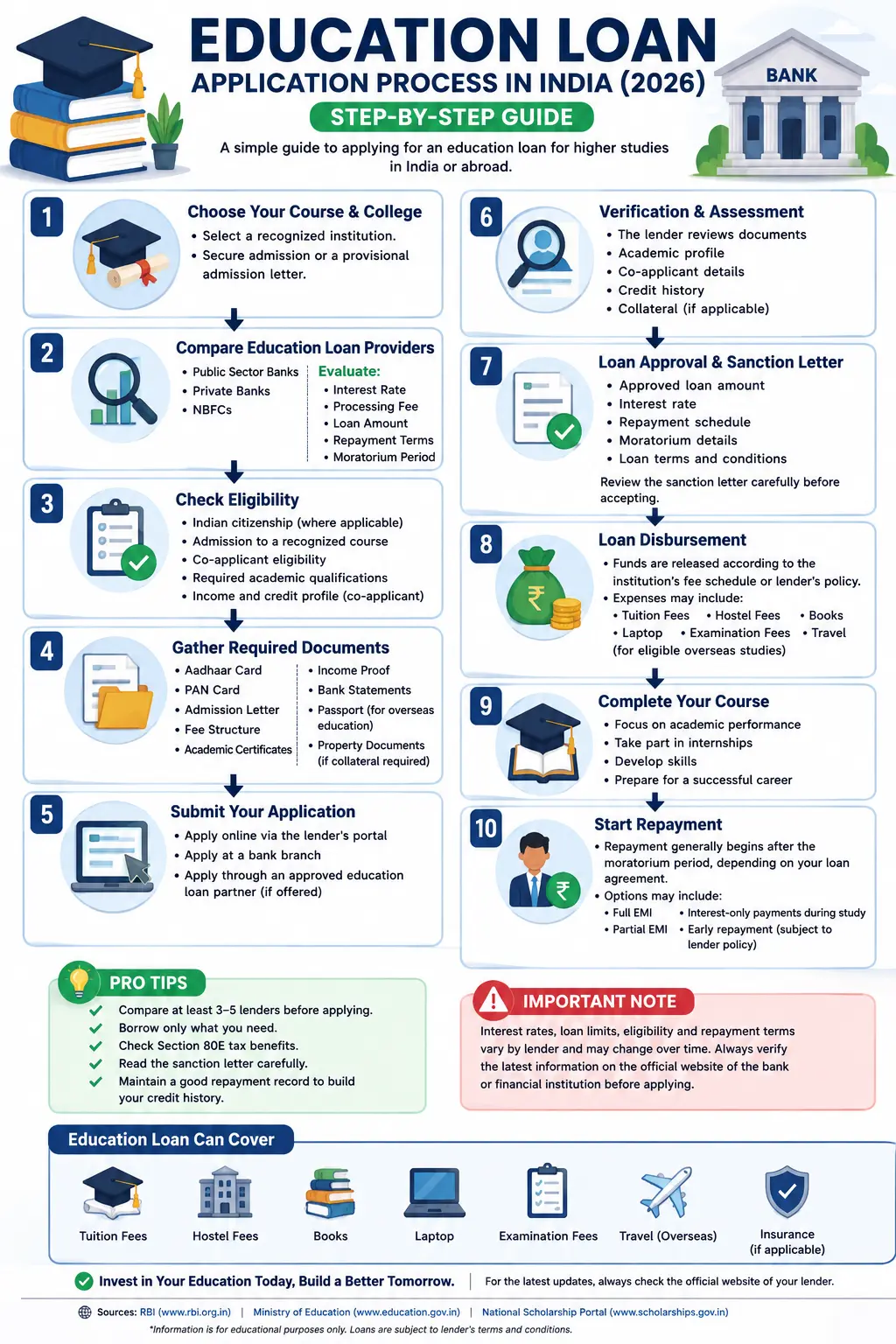
Education Loan Application Process in India (2026) – Step-by-Step Guide
A simple guide to applying for an education loan for higher studies in India or abroad.
Step 1: Choose Your Course & College
- Select a recognized institution.
- Secure admission or a provisional admission letter.
Step 2: Compare Education Loan Providers
Compare:
- Public Sector Banks
- Private Banks
- NBFCs
Evaluate:
- Interest Rate
- Processing Fee
- Loan Amount
- Repayment Terms
- Moratorium Period
Step 3: Check Eligibility
Confirm:
- Indian citizenship (where applicable)
- Admission to a recognized course
- Co-applicant eligibility
- Required academic qualifications
- Income and credit profile (co-applicant)
Step 4: Gather Required Documents
Prepare:
- Aadhaar Card
- PAN Card
- Admission Letter
- Fee Structure
- Academic Certificates
- Income Proof
- Bank Statements
- Passport (for overseas education)
- Property Documents (if collateral is required)
Step 5: Submit Your Application
Apply:
- Online via the lender’s portal
- At a bank branch
- Through an approved education loan partner (if offered)
Step 6: Verification & Assessment
The lender reviews:
- Documents
- Academic profile
- Co-applicant details
- Credit history
- Collateral (if applicable)
Step 7: Loan Approval & Sanction Letter
Receive:
- Approved loan amount
- Interest rate
- Repayment schedule
- Moratorium details
- Loan terms and conditions
Review the sanction letter carefully before accepting.
Step 8: Loan Disbursement
Funds are released according to the institution’s fee schedule or the lender’s policy.
Expenses may include:
- Tuition Fees
- Hostel Fees
- Books
- Laptop
- Examination Fees
- Travel (for eligible overseas studies)
Step 9: Complete Your Course
Focus on:
- Academic performance
- Internship opportunities
- Skill development
- Career preparation
Step 10: Start Repayment
Repayment generally begins after the moratorium period, depending on your loan agreement.
Options may include:
- Full EMI
- Interest-only payments during study
- Partial EMI
- Early repayment (subject to lender policy)
💡 Pro Tips
- ✔ Compare at least 3–5 lenders before applying.
- ✔ Borrow only what you need.
- ✔ Check Section 80E tax benefits.
- ✔ Read the sanction letter carefully.
- ✔ Maintain a good repayment record to build your credit history.
⚠️ Important Note
Interest rates, loan limits, eligibility, and repayment terms vary by lender and may change over time. Always verify the latest information on the official website of the bank or financial institution before applying.
Collateral Requirements
Whether collateral is required depends on the loan amount, lender policy, course, and institution.
Common Types of Collateral
- Residential property
- Commercial property
- Fixed deposits
- Government securities
- Approved financial assets
Some lenders may offer unsecured education loans for eligible students admitted to reputed institutions.
Margin Money
Margin money is the amount that students or parents contribute toward educational expenses.
Example:
- Course Cost: ₹20,00,000
- Loan Approved: ₹18,00,000
- Student Contribution: ₹2,00,000
Margin requirements differ across lenders and loan schemes.
Moratorium Period
The moratorium period is the duration during which repayment of the principal is deferred.
It generally includes:
- Course duration
- Plus an additional period after course completion (subject to lender policy)
Interest treatment during this period varies by lender.
Education Loan EMI
Your EMI depends on:
- Loan amount
- Interest rate
- Loan tenure
- Repayment schedule
Example
| Loan Amount | Interest Rate | Tenure | Approx. EMI* |
| ₹5 Lakh | 9% | 7 Years | Lower EMI |
| ₹10 Lakh | 9.5% | 10 Years | Moderate EMI |
| ₹20 Lakh | 10% | 15 Years | Higher EMI |
*Illustrative only. Use the lender’s official EMI calculator for accurate figures.
Repayment Options
Most lenders offer flexible repayment methods.
Option 1: EMI after the moratorium.
Option 2: Simple interest during the study period.
Option 3: Partial EMI during the course.
Option 4: Full EMI from the date of disbursement.
Repayment Comparison
| Repayment Method | Suitable For |
| Full Moratorium | Students without income |
| Interest Only | Parents with stable income |
| Partial EMI | Lower future repayment burden |
| Full EMI | Lowest total interest cost |
Tax Benefits Under Section 80E
Education loans may qualify for tax benefits under Section 80E of the Income Tax Act, subject to applicable conditions.
Key Benefits
- Deduction on interest paid
- No upper monetary limit on eligible interest deduction
- Available for a specified period as per tax provisions
- Applicable only to eligible education loans
Consult a qualified tax professional or refer to the latest Income Tax rules to understand current eligibility and limits.
Advantages of Education Loans
- Makes higher education affordable
- Preserves family savings
- Flexible repayment options
- Moratorium period
- Tax benefits
- Builds credit history with timely repayment
- Supports international education
- Covers a wide range of educational expenses
Disadvantages of Education Loans
- Long-term financial commitment
- Interest increases total education cost
- Credit score affects approval
- Collateral may be required
- Delayed repayment can impact credit history
- Processing time varies by lender
Common Mistakes to Avoid
❌ Applying to only one lender
❌ Ignoring processing fees
❌ Not comparing total borrowing costs
❌ Choosing the longest tenure without understanding interest impact
❌ Borrowing more than required
❌ Missing EMI payments
❌ Not reading the sanction letter carefully
❌ Ignoring insurance requirements
❌ Failing to check prepayment conditions
❌ Relying solely on advertisements instead of official lender information
Warning Box
Always read the complete loan agreement before signing. Pay close attention to the interest rate type (fixed or floating), processing fees, moratorium conditions, prepayment rules, penalties, insurance requirements, and collateral terms. Even small differences can significantly affect the total repayment amount over the life of the loan.
Expert Tips
- Compare at least 3–5 lenders before making a decision.
- Apply only after receiving a confirmed admission offer.
- Borrow only the amount you genuinely need.
- Maintain a strong credit profile for the co-applicant.
- Use scholarships, grants, and internships to reduce your borrowing requirement.
- Prefer lenders with transparent fees and flexible repayment options.
- Keep digital copies of all submitted documents.
- Track disbursements and repayment schedules carefully.
Latest Updates (2026)
Important: Education loan policies, interest rates, eligibility requirements, government subsidy schemes, and lender-specific terms are revised periodically. Before submitting your application, verify the latest details on the official website of the respective bank, NBFC, or government department.
Key Trends in 2026
- Digital education loan applications continue to grow.
- Faster document verification through online KYC.
- Increased funding options for study-abroad programs.
- Greater focus on skill-based and employability-oriented courses.
- More lenders offer partially unsecured loans for students admitted to reputed institutions.
- Improved online loan tracking and disbursement systems.
- Enhanced use of credit assessment for co-applicants.
Did You Know?
💡 According to industry trends, tuition fees are only one part of the total cost of higher education. Many education loans may also cover:
- Hostel fees
- Examination fees
- Books
- Laptops
- Study materials
- Laboratory charges
- Educational tours
- Airfare (for overseas studies)
- Insurance (subject to lender policy)
Expert Insight
Choosing the lowest interest rate does not always mean choosing the best education loan.
When comparing lenders, consider:
- Total borrowing cost
- Processing fees
- Floating vs. fixed interest rate
- Moratorium conditions
- Prepayment flexibility
- Customer support
- Loan disbursement process
- Digital services
- Repayment assistance
A transparent lender with flexible repayment options can be a better long-term choice than one offering only a slightly lower interest rate.
Final Verdict
Education is one of the most valuable long-term investments, and an education loan can help bridge the financial gap without delaying academic goals.
Before applying:
- Compare multiple banks and NBFCs.
- Read the loan agreement carefully.
- Borrow only the amount you genuinely need.
- Understand repayment obligations.
- Check for government subsidy schemes if eligible.
- Calculate your expected EMI before accepting the offer.
- Verify all information with the official lender.
Taking time to compare lenders and understand the complete cost of borrowing can save significant money over the life of the loan.
Conclusion – Best Education Loan in India 2026
Choosing the best education loan in India is one of the most important financial decisions for students and parents. While an education loan can make higher education more accessible, selecting the right lender requires careful comparison of interest rates, processing fees, loan amount, repayment tenure, moratorium period, collateral requirements, and overall borrowing costs.
Before applying, compare multiple public sector banks, private banks, and NBFCs instead of relying on a single option. Read the loan agreement carefully, understand all applicable charges, calculate your expected EMI, and borrow only the amount you genuinely need. If you’re eligible, explore government interest subsidy schemes and scholarship opportunities to reduce your overall financial burden.
Remember that the lowest interest rate is not always the best deal. Flexible repayment options, transparent terms, responsive customer service, and minimal hidden charges can make a significant difference over the life of your loan.
Finally, always verify the latest eligibility criteria, interest rates, and loan terms on the official website of the respective lender before submitting your application, as policies and products may change over time.
With proper research and informed planning, an education loan can become a valuable investment in your future—helping you pursue your academic goals, build professional skills, and create long-term career opportunities with confidence.
You May Like More
- PM Internship Scheme Certificate Benefits: Why It Matters for Your Career (2026 Guide)
- pminternship.mca.gov.in Login: Complete Guide to Access Your PM Internship Scheme Account (2026)
- PM Internship Scheme Dashboard Guide 2026: Complete Features, Login, Profile & Application Tracking
Best Education Loan in India 2026 FAQs: 20+ Most Asked Questions with Detailed Answers (Latest Guide)
1. Which is the best education loan in India?
The best education loan depends on your course, institution, loan amount, repayment capacity, and lender terms. Compare interest rates, processing fees, repayment options, and customer service before deciding.
2. What is the minimum interest rate for an education loan?
Interest rates vary by lender, course, credit profile, and market conditions. Public sector banks often offer competitive rates, but always verify the latest figures on the lender’s official website.
3. Can I get an education loan without collateral?
Yes. Some lenders provide unsecured education loans for eligible students, especially those admitted to reputed institutions. Availability depends on the lender’s policy and the applicant’s profile.
4. Is a co-applicant mandatory?
In many cases, yes. A parent, guardian, or spouse typically acts as the co-applicant and supports the loan application.
5. What expenses are covered under an education loan?
Eligible expenses may include tuition fees, hostel charges, books, examination fees, laptops, equipment, travel (for overseas studies), insurance, and other approved educational costs.
6. Can I apply before getting admission?
Most lenders require proof of admission to a recognized institution before processing the loan.
7. How long does loan approval take?
Approval timelines vary depending on the lender, document completeness, and verification process.
8. Can I prepay my education loan?
Many lenders allow prepayment. Check whether any conditions or charges apply before making early repayments.
9. What is a moratorium period?
It is the period during which repayment of the principal is deferred, generally covering the course duration plus an additional period as defined by the lender.
10. Can I get a loan for studying abroad?
Yes. Many banks and NBFCs offer education loans for approved international universities and courses.
11. Does an education loan improve my credit score?
Timely repayment can help build a positive credit history, while missed payments may negatively affect your credit score.
12. Is there any tax benefit on education loans?
Interest paid on eligible education loans may qualify for deductions under Section 80E of the Income Tax Act, subject to applicable conditions.
13. Can I get a loan for diploma or certificate courses?
Yes. Many lenders finance approved diploma, vocational, and professional certification programs.
14. What is margin money?
Margin money is the portion of the education cost that the student or family contributes, with the remaining amount financed by the lender.
15. Are processing fees refundable?
Generally, processing fees are non-refundable, but this depends on the lender’s policy.
16. Can I switch my education loan to another bank?
Some lenders allow balance transfers. Compare costs and benefits before switching.
17. What happens if I miss an EMI?
Missing repayments may lead to penalties and can adversely affect your credit history. Contact your lender immediately if you anticipate repayment difficulties.
18. Can scholarships and education loans be used together?
Yes. Scholarships reduce the total education cost and may lower the amount you need to borrow.
19. Can working professionals apply for education loans?
Yes. Many lenders offer education loans for working professionals pursuing higher education or executive programs.
20. Should I compare multiple lenders before applying?
Absolutely. Comparing interest rates, repayment flexibility, fees, and loan terms helps you choose the most suitable option.
Appendix – Best Education Loan in India 2026
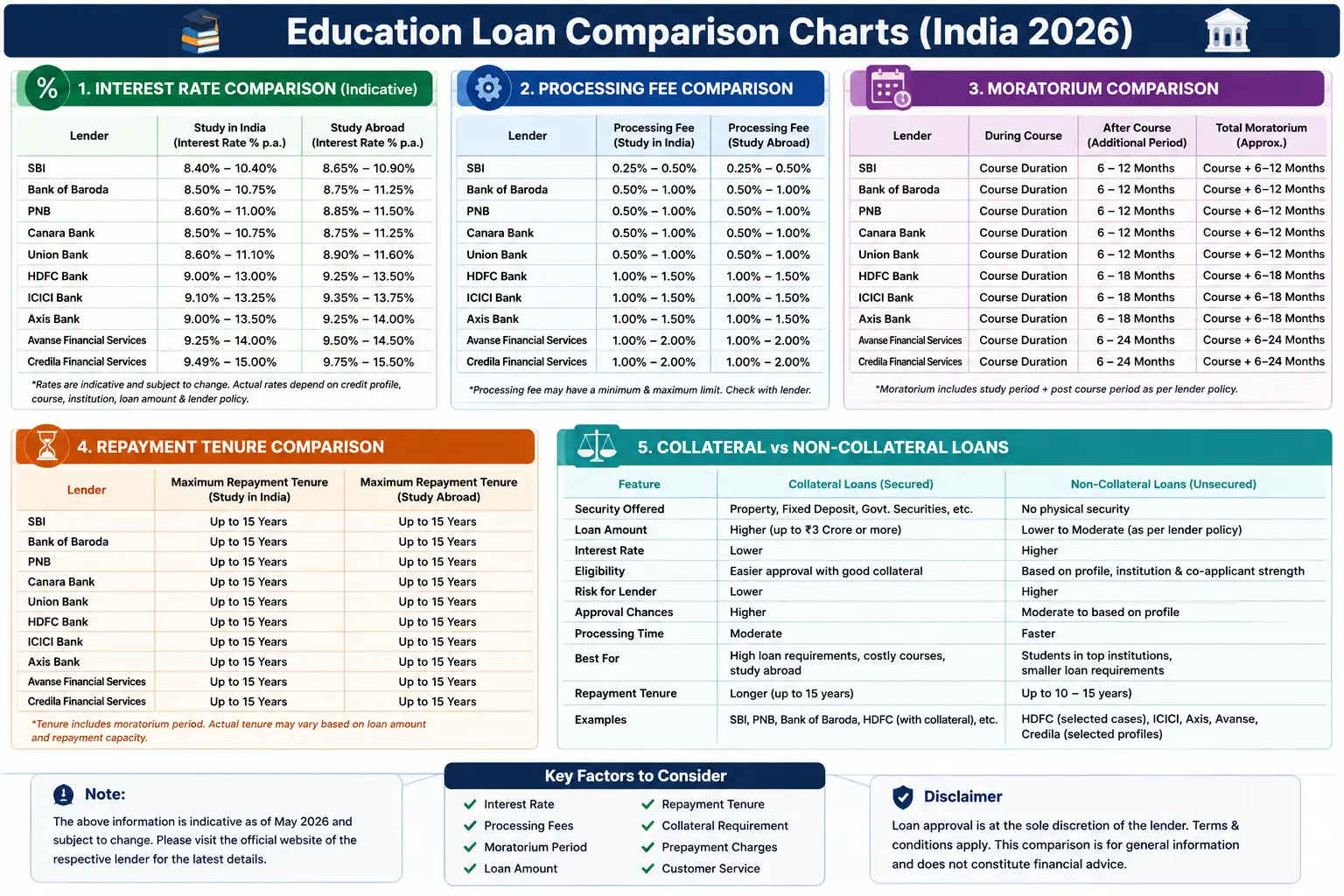
1. Top Education Loan Providers Comparison (2026)
| Lender | Study in India | Study Abroad | Collateral-Free* | Tax Benefit | Online Apply |
| SBI | ✓ | ✓ | Available for eligible cases | ✓ | ✓ |
| Bank of Baroda | ✓ | ✓ | Lender policy applies | ✓ | ✓ |
| PNB | ✓ | ✓ | Lender policy applies | ✓ | ✓ |
| Canara Bank | ✓ | ✓ | Lender policy applies | ✓ | ✓ |
| Union Bank | ✓ | ✓ | Lender policy applies | ✓ | ✓ |
| HDFC Bank | ✓ | ✓ | Selected profiles | ✓ | ✓ |
| ICICI Bank | ✓ | ✓ | Selected profiles | ✓ | ✓ |
| Axis Bank | ✓ | ✓ | Selected profiles | ✓ | ✓ |
| Credila | — | ✓ | Selected profiles | ✓ | ✓ |
| Avanse | ✓ | ✓ | Selected profiles | ✓ | ✓ |
*Availability depends on the lender, institution, and applicant profile.
2. Education Loan EMI Examples
| Loan | Interest | Tenure | Approx. EMI* |
| ₹5 Lakh | 9% | 7 Years | Illustrative |
| ₹10 Lakh | 9.5% | 10 Years | Illustrative |
| ₹20 Lakh | 10% | 15 Years | Illustrative |
| ₹30 Lakh | 10% | 15 Years | Illustrative |
Use your lender’s official EMI calculator for accurate results.
3. Education Loan vs Scholarship
| Education Loan | Scholarship |
| Must be repaid | No repayment |
| Interest applicable | No interest |
| Larger funding possible | Limited amount |
| Available from banks/NBFCs | Government/private organizations |
| Tax benefits may apply | Not applicable |
4. Education Loan vs Personal Loan
| Education Loan | Personal Loan |
| Designed for education expenses | General-purpose borrowing |
| Often lower interest | Usually higher interest |
| Moratorium available | Generally not available |
| Section 80E tax benefit | No Section 80E benefit |
| Longer repayment tenure | Typically shorter tenure |
5. Checklist Before Applying
- ☐ Compare at least 5 lenders.
- ☐ Verify the institution is recognized.
- ☐ Calculate the total borrowing cost.
- ☐ Review processing fees.
- ☐ Understand the moratorium period.
- ☐ Check collateral requirements.
- ☐ Confirm prepayment rules.
- ☐ Read the sanction letter carefully.
- ☐ Keep digital copies of all documents.
- ☐ Apply only after confirming admission.
6. Common Reasons for Loan Rejection
- Incomplete application
- Low co-applicant income
- Poor credit history
- Unrecognized institution
- Insufficient collateral (where required)
- Missing documents
- Inconsistent information
- Failure to meet lender eligibility criteria
Disclaimer: This article is for educational and informational purposes only. Some parts of this content are generated with the assistance of Artificial Intelligence (AI) and have been reviewed for accuracy; however, errors or omissions may still occur. Education loan interest rates, eligibility, fees, repayment terms, and government schemes may change over time. Always verify the latest information with the official website of the respective bank, NBFC, or government authority before making any financial decision. pminternshipscheme.com is an independent informational website and is not affiliated with or endorsed by any lender or government agency unless explicitly stated. Please consult a qualified financial advisor if you need personalized financial or tax advice.