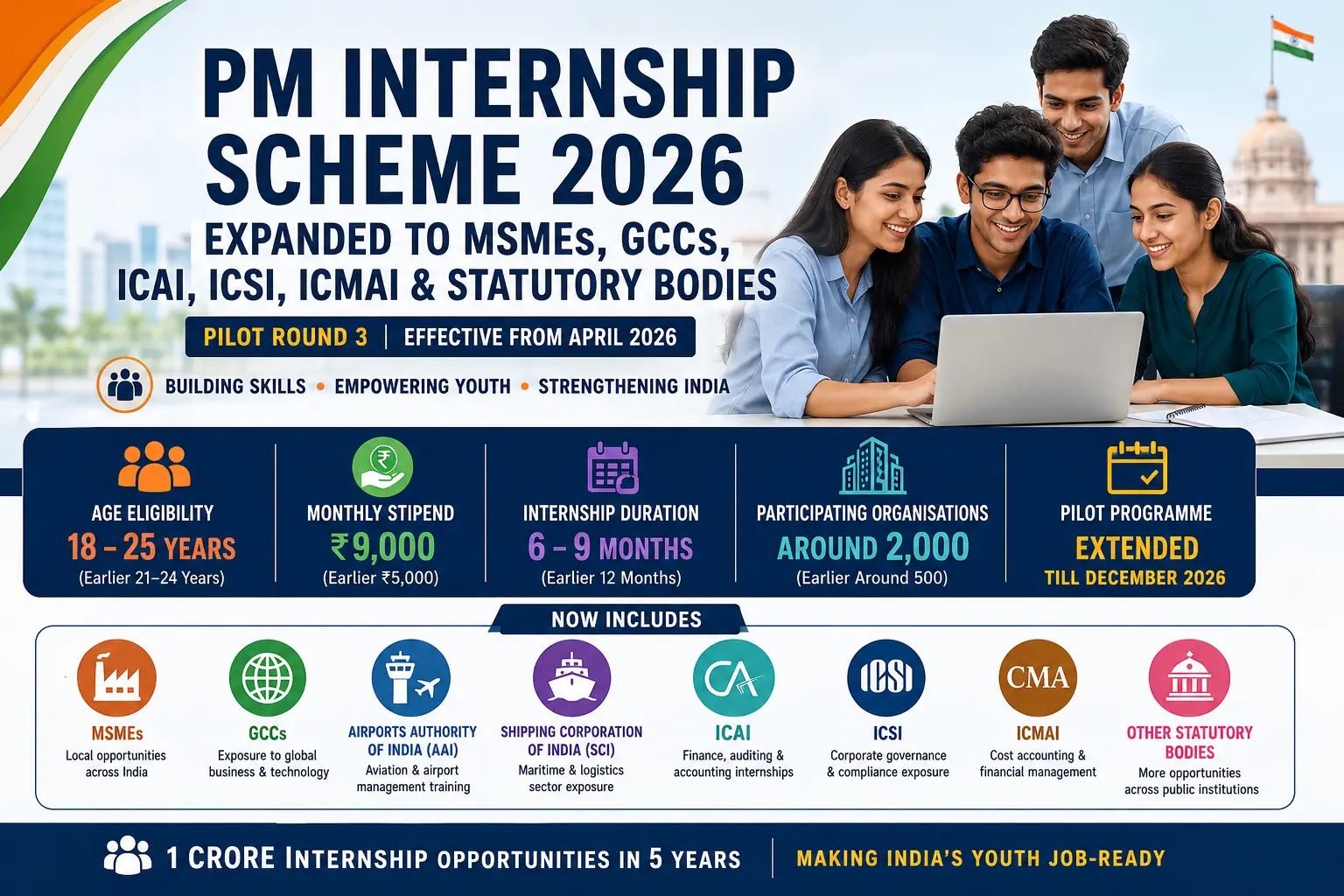
The PM Internship Scheme 2026 has received a major boost as the Central Government expands the programme under Pilot Round 3 by allowing MSMEs, Global Capability Centres (GCCs), statutory bodies, and leading professional institutes to participate.
The latest reforms aim to make internships more accessible, locally available, and industry-focused for young job seekers across India. Along with widening organisational participation, the government has increased the monthly stipend to ₹9,000, expanded the eligible age to 18–25 years, reduced the internship duration to 6–9 months, and extended the pilot phase until December 2026.
These changes are expected to improve employability, strengthen industry-academia collaboration, and help the PM Internship Scheme 2026 create more meaningful internship opportunities for India’s youth.
PM Internship Scheme 2026 Expanded: Centre Includes MSMEs, GCCs, ICAI & Statutory Bodies Under Pilot Round 3
The Prime Minister Internship Scheme (PMIS) has entered a new phase with the Government of India announcing a major expansion under Pilot Round 3, effective from April 2026. The latest reforms are aimed at making internships more accessible, industry-oriented, and beneficial for India’s youth.
One of the biggest highlights of this expansion is the inclusion of Micro, Small and Medium Enterprises (MSMEs), Global Capability Centres (GCCs), statutory bodies, Airports Authority of India (AAI), Shipping Corporation of India (SCI), ICAI, ICSI, ICMAI, and several other institutions. These additions are expected to significantly increase internship opportunities across India while making them available closer to students’ hometowns.
The Government has also revised several key provisions of the scheme, including increasing the monthly stipend to ₹9,000, widening the eligible age group to 18–25 years, reducing the internship duration to 6–9 months, and extending the pilot programme until December 2026.
This article explains every important aspect of the PM Internship Scheme 2026, the reasons behind its expansion, the latest changes introduced under Pilot Round 3, and how these reforms are expected to improve youth employability in India.
Why is PM Internship Scheme 2026 in News?
The Union Government has announced significant reforms to the Prime Minister Internship Scheme (PMIS) after reviewing the performance of the first two pilot rounds.
Although companies had offered more than 1.65 lakh internship opportunities, the number of candidates who actually joined remained much lower than expected. The government found several practical issues that discouraged participation, including:
- Limited availability of internships near students’ hometowns
- Long internship duration
- Limited participation from local industries
- Travel and relocation expenses
- Lack of awareness among eligible youth
To address these challenges, the Government has redesigned the programme by expanding the number and type of participating organisations while making internships shorter, better paid, and geographically accessible.
PM Internship Scheme 2026: Overview
| Particular | Details |
| Scheme Name | Prime Minister Internship Scheme (PMIS) |
| Launched | October 2024 |
| Implementing Ministry | Ministry of Corporate Affairs (MCA) |
| Objective | Improve employability through structured paid internships |
| Internship Type | Paid Internship Programme |
| Pilot Round 3 | Effective from April 2026 |
| Current Target | 1.10 lakh internship opportunities till December 2026 |
| Long-Term Target | 1 Crore internship opportunities in five years |
Historical Background of PM Internship Scheme
India possesses one of the world’s largest youth populations. Every year, millions of students graduate from universities, engineering colleges, Industrial Training Institutes (ITIs), and vocational institutions. However, employers frequently report that many graduates lack practical workplace experience despite having academic qualifications.
This mismatch between education and industry requirements has remained a significant challenge for India’s labour market.
Several studies by industry associations and government agencies have repeatedly highlighted that employers spend considerable resources on training fresh graduates before they become productive employees.
Recognising this gap, the Government launched the Prime Minister Internship Scheme (PMIS) in October 2024 under the Ministry of Corporate Affairs.
Unlike conventional classroom-based skill development programmes, PMIS focuses on providing real workplace exposure, enabling young people to develop professional skills while earning a monthly stipend.
The scheme also supports India’s long-term employment strategy by creating stronger connections between educational institutions and industries.
Why Did the Government Revamp PM Internship Scheme 2026?
Following the completion of the first two pilot rounds, the Ministry of Corporate Affairs analysed participation data and identified several concerns.
While companies generated thousands of internship opportunities, actual joining numbers remained considerably lower.
The Government identified multiple reasons behind this trend:
- Internship locations were often far from candidates’ hometowns.
- Relocation expenses discouraged many applicants.
- The original internship duration of 12 months appeared too long.
- Limited company participation reduced geographical coverage.
- Students preferred opportunities available closer to their educational institutions.
Instead of merely increasing internship offers, the Government decided to redesign the programme to improve accessibility, flexibility, affordability, and completion rates.
Major Reforms Introduced Under PM Internship Scheme 2026 Pilot Round 3
The Government has announced several major reforms that significantly improve the attractiveness of PMIS.
| Reform | Earlier Provision | Revised Provision (Pilot Round 3) |
| Eligible Age | 21–24 years | 18–25 years |
| Monthly Stipend | ₹5,000 | ₹9,000 |
| Internship Duration | 12 months | 6–9 months |
| Participating Companies | Around 500 | Around 2,000 |
| Pilot Programme | Limited Period | Extended till December 2026 |
These reforms aim to improve candidate participation while encouraging more organisations to become internship partners.
Major Expansion: New Organisations Now Eligible Under PMIS
Perhaps the most significant announcement is the expansion of eligible organisations.
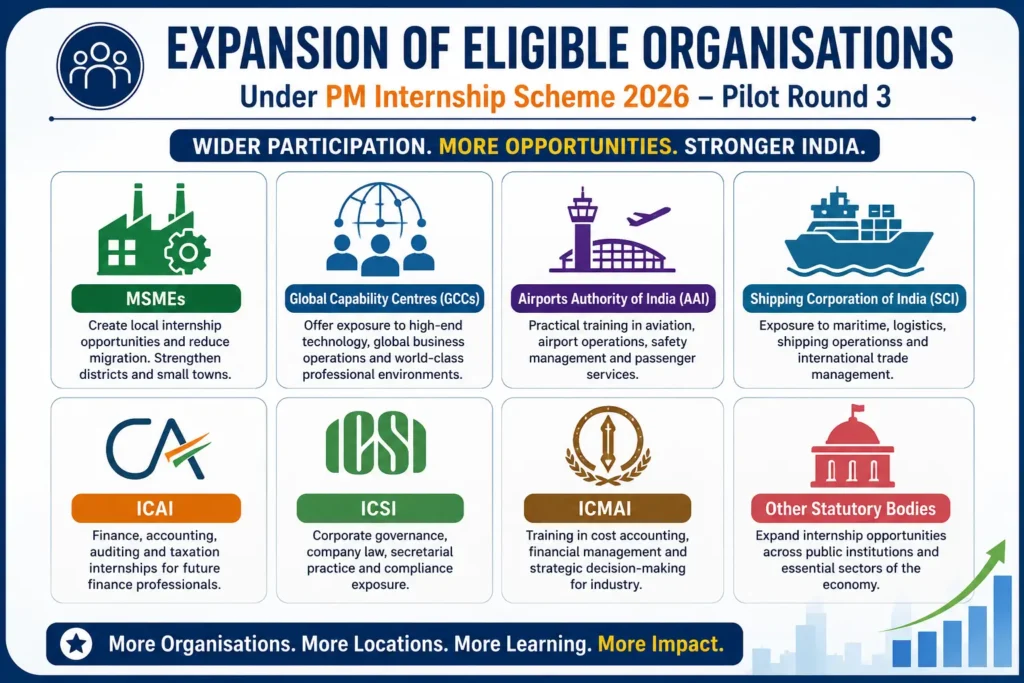
Earlier, internships were largely limited to some of India’s largest companies. Pilot Round 3 broadens participation by including numerous additional institutions.
Newly Eligible Organisations
| Organisation | Importance |
| MSMEs | Create local internship opportunities across districts |
| Global Capability Centres (GCCs) | Exposure to global business operations |
| Airports Authority of India (AAI) | Aviation sector internships |
| Shipping Corporation of India (SCI) | Maritime and logistics training |
| ICAI | Accounting and auditing internships |
| ICSI | Corporate governance and compliance |
| ICMAI | Cost accounting and financial management |
| Statutory Bodies | Public sector professional experience |
This expansion is expected to significantly increase internship opportunities throughout India.
Why Were MSMEs Included?
The inclusion of Micro, Small and Medium Enterprises (MSMEs) is considered one of the most transformative changes under PM Internship Scheme 2026.
MSMEs contribute substantially to India’s manufacturing output, exports, and employment generation. They are widely distributed across districts, towns, and rural regions, unlike large corporations that are concentrated in metropolitan cities.
The Government expects several benefits from MSME participation.
Benefits of MSME Inclusion
Local Internship Opportunities
Students will have better access to internships near their hometowns.
Reduced Migration
Candidates may no longer need to relocate to major cities merely for internship opportunities.
Lower Financial Burden
Reduced travel and accommodation costs can improve participation among economically weaker candidates.
Stronger Local Industries
MSMEs will benefit by accessing energetic young interns who can contribute fresh ideas and digital skills.
Better Regional Development
Tier-2 and Tier-3 cities are expected to witness increased internship activity, strengthening local employment ecosystems.
Importance of Global Capability Centres (GCCs)
Another landmark reform is the inclusion of Global Capability Centres (GCCs).
GCCs are specialised centres established by multinational corporations to manage global operations from India.
These centres work across advanced sectors such as:
- Artificial Intelligence
- Software Development
- Cybersecurity
- Data Analytics
- Financial Services
- Cloud Computing
- Research & Development
- Engineering Services
- Business Process Management
Internships in GCCs can provide exposure to international work environments and advanced technologies.
Young professionals participating in GCC internships may develop globally relevant skills, making them more competitive in domestic as well as international job markets.
Greater Role for State Governments
The revised PM Internship Scheme also introduces a stronger role for State Governments.
Each state can now nominate up to 20 companies for participation in the internship programme.
This decentralised approach offers several advantages:
- Better alignment with regional industries.
- Greater representation of local employers.
- Improved internship availability.
- Promotion of cooperative federalism.
- Support for state-specific employment priorities.
States can now recommend industries that play a significant role in their local economies but may not have qualified under earlier central criteria.
Corporate Eligibility Criteria
While the Government has expanded participation, certain financial eligibility standards continue to ensure quality internship opportunities.
| Eligibility Parameter | Requirement |
| CSR Requirement | Average CSR expenditure during previous three financial years |
| Additional Requirement | Annual turnover above ₹1,000 crore |
| Alternative Requirement | Net worth above ₹500 crore |
These conditions help maintain organisational capability to provide structured internships with adequate mentoring and workplace exposure.
Performance of the First Two Pilot Rounds
The Government’s decision to redesign PMIS was based on actual implementation data.
| Pilot Round | Internship Offers | Candidates Joined |
| Round 1 | Over 82,000 | 8,760 |
| Round 2 | Over 83,000 | Around 7,300 |
Together, the first two rounds generated more than 1.65 lakh internship opportunities, yet joining rates remained relatively low.
The Government concluded that simply increasing internship offers was insufficient.
Instead, internships needed to become:
- Closer to candidates’ homes
- Financially attractive
- Easier to access
- Better aligned with student preferences
- Available across more industries
Government’s New Strategy for PM Internship Scheme 2026
To improve implementation, the Government has adopted a broader outreach strategy.
Major initiatives include:
- Partnership with National Cadet Corps (NCC) for grassroots mobilisation.
- Collaboration with MY Bharat (Mera Yuva Bharat) to improve youth awareness.
- Engagement with MSME clusters to increase local internships.
- Increased stipend of ₹9,000.
- Reduced internship duration.
- Inclusion of statutory bodies.
- Expansion of participating companies from around 500 to nearly 2,000.
- Better digital monitoring and candidate support.
The Government now aims to improve participation, retention, and successful completion rather than merely increasing internship numbers.
How PM Internship Scheme Benefits India’s Economy
The expanded PMIS has implications that extend beyond internship opportunities.
1. Employment Generation
Students gain practical workplace experience before entering the job market.
Employers receive candidates who are better prepared for professional responsibilities.
2. Skill Development
Internships bridge the gap between classroom education and industry expectations.
Students acquire technical skills, communication abilities, teamwork experience, and workplace ethics.
3. MSME Growth
Local industries gain access to trained interns who can contribute to innovation, productivity, and digital transformation.
4. Demographic Dividend
India’s large youth population represents a major economic advantage.
PMIS can help convert this demographic strength into a skilled and productive workforce capable of supporting long-term economic growth.
5. Easier Hiring for Companies
Companies can evaluate interns during the programme and recruit high-performing candidates later.
This reduces recruitment costs and onboarding time.
6. Regional Economic Development
By promoting internships in Tier-2 and Tier-3 cities, the scheme can stimulate local economies while reducing migration pressures on metropolitan areas.
PM Internship Scheme Challenges Ahead
Despite the major reforms, certain implementation challenges remain.
Maintaining Internship Quality
Thousands of participating organisations will require effective monitoring to ensure quality learning experiences.
Mentorship in MSMEs
Many smaller enterprises may not yet possess structured mentoring systems.
Training standards may therefore vary considerably.
Female Participation
Mobility, accommodation, and safety concerns could continue to limit female participation in certain regions.
Additional support mechanisms may be necessary.
Employment Outcomes
Internships should ideally lead to long-term employment opportunities.
Continuous tracking of post-internship placements will help evaluate the scheme’s effectiveness.
Way Forward PM Internship Scheme
Experts believe that PM Internship Scheme can become one of India’s most impactful employability programmes if implementation remains strong.
Some recommended measures include:
- Establishing a comprehensive digital monitoring system.
- Tracking internship quality and completion rates.
- Collecting regular feedback from interns and employers.
- Strengthening partnerships with universities, ITIs, Skill India centres, and State Governments.
- Promoting internships in emerging sectors such as Artificial Intelligence, renewable energy, semiconductors, robotics, and advanced manufacturing.
- Encouraging companies to offer permanent employment to successful interns through hiring incentives.
- Enhancing awareness campaigns among rural youth and educational institutions.
If implemented effectively, PMIS could become a cornerstone of India’s long-term workforce development strategy.
You May Read More Helpful Articles:
- PM Internship Scheme Selection Process 2026 [Step-by-Step Guide]
- PM Internship Scheme Age Limit 2026: Minimum & Maximum Age [Official Rules]
- PM Internship Scheme Apply Link 2026 (Direct Official Link)
Conclusion – PM Internship Scheme 2026 Expanded
The expansion of the Prime Minister Internship Scheme (PMIS) 2026 marks a significant step toward improving employability, strengthening industry-academia collaboration, and making internships more accessible across India.
By including MSMEs, Global Capability Centres (GCCs), ICAI, ICSI, ICMAI, Airports Authority of India, Shipping Corporation of India, and various statutory bodies, the Government has substantially widened the scope of the programme.
The revised eligibility criteria, higher monthly stipend of ₹9,000, reduced internship duration, expanded age limit, and increased participation from industries collectively make Pilot Round 3 far more attractive than earlier rounds.
If implemented effectively with robust monitoring, high-quality mentoring, and stronger collaboration among governments, educational institutions, and industry, the PM Internship Scheme has the potential to transform India’s youth into a highly skilled workforce while contributing significantly to the nation’s economic growth.
Frequently Asked Questions (FAQs) about PM Internship Scheme 2026 Expanded
1. What is the Prime Minister Internship Scheme (PMIS)?
The Prime Minister Internship Scheme (PMIS) is a Government of India initiative launched in October 2024 by the Ministry of Corporate Affairs to provide paid internships that improve employability through practical industry experience.
2. Why has the Government expanded PMIS to MSMEs?
MSMEs are spread across districts and smaller towns, allowing students to undertake internships closer to their homes. This reduces relocation costs, improves accessibility, and increases participation.
3. Which ministry implements the PM Internship Scheme?
The Ministry of Corporate Affairs (MCA) is the nodal ministry responsible for implementing and monitoring the Prime Minister Internship Scheme.
4. What are the major changes introduced under Pilot Round 3?
The key changes include:
- Age eligibility expanded from 21–24 years to 18–25 years
- Monthly stipend increased from ₹5,000 to ₹9,000
- Internship duration reduced from 12 months to 6–9 months
- Eligible organisations expanded to include MSMEs, GCCs, ICAI, ICSI, ICMAI, AAI, SCI, and statutory bodies
- Pilot programme extended until December 2026
5. What are Global Capability Centres (GCCs)?
Global Capability Centres are offshore facilities established by multinational companies in India to manage high-value business operations such as AI, software development, engineering, finance, cybersecurity, research, and data analytics.
6. How will MSMEs benefit from PM Internship Scheme 2026?
MSMEs will gain access to trained young talent, strengthen their workforce, improve productivity, and contribute to local employment generation while helping students gain practical experience close to their hometowns.
7. Why was the internship duration reduced?
The Government reduced the internship period from 12 months to 6–9 months to make the programme more flexible, improve candidate participation, and increase internship completion rates.
8. What is the long-term goal of the PM Internship Scheme?
The Government aims to create 1 crore internship opportunities over five years, enabling millions of young Indians to gain industry experience and improve their employment prospects.